KGSP Scholarship 2026: Complete Guide to Study in Korea
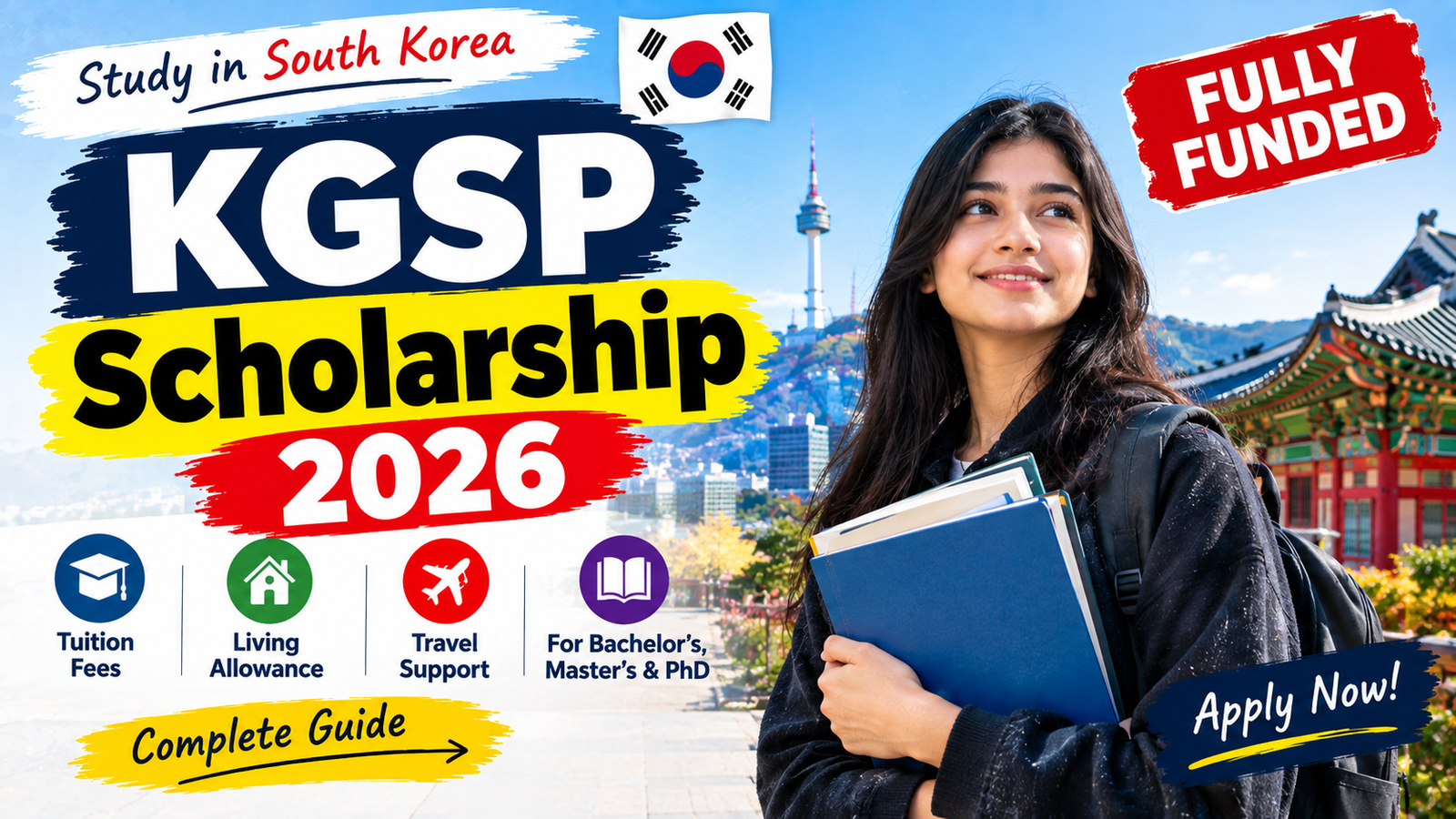
If you’ve been dreaming about studying in South Korea but the costs feel impossible, this KGSP Scholarship complete guide is exactly what you need right now. The Korean Government Scholarship Program officially called the Global Korea Scholarship (GKS) these days is one of the most generous fully-funded opportunities available to international students. We’re talking about full tuition, living expenses, airfare, and even a year of free Korean language training.
But here’s the thing: it’s also competitive. Really competitive. Every year, thousands of students from over 150 countries apply for roughly 2K spots. So how do you stand out? How do you avoid the mistakes that get applications rejected before they’re even properly reviewed?
What Is the KGSP Scholarship?
The KGSP is a scholarship initiative sponsored by the Korean government and supervised by the National Institute for International Education. The program is over 50 years old, having been launched in 1967, making it one of the oldest international scholarship programs across Asia.
The scholarship is provided for all learning levels such as research programs, graduate degrees and undergraduate degrees. For this guide, the emphasis would be primarily on a graduate track as this would be the preference of most international applicants, though principles may apply to other programs as well. KGSP Scholarship.
What makes KGSP different from other scholarships? one-year Korean language program. Before you start your actual degree, you’ll spend a year learning Korean at a designated language institution. You need to reach TOPIK Level 3 to begin your degree studies. That’s right the scholarship doesn’t just fund your degree, it prepares you to actually thrive in Korea.
Eligibility Criteria For KGSP Scholarship
Let’s be straightforward about this the eligibility requirements are strict, and you need to check them before you invest hours into your application.
Nationality Requirements
You must be a citizen of a country invited to participate in the program. Neither you nor your parents can hold Korean citizenship. If you previously held Korean citizenship, you’ll need to submit proof of renunciation. KGSP Scholarship.
Age Limit
For graduate programs, you must be under 40 years old at the time of application. That means born after September 1, 1986 for the 2026 cycle.
Academic Requirements
- Master’s applicants: Need a Bachelor’s degree or equivalent
- Doctoral candidates: Master’s or higher equivalent required
Your other marks also count. In most cases, you will require 80% and above in CGPA scale or if only percentile then the best 20% in your class.
Health Requirements
You need to be in good physical and mental health to complete the program. A comprehensive medical exam is required for successful candidates before final selection.
Who Cannot Apply
- Current or former KGSP scholars who had their scholarship cancelled
- Anyone who has already received a Korean government scholarship
- Korean citizens
What Does the KGSP Scholarship Cover?
This is where the KGSP really shines. Here’s what you get:
| Benefit | Details |
|---|---|
| Airfare | Round-trip economy class ticket |
| Settlement Allowance | 200,000 KRW upon arrival |
| Monthly Stipend | 1,000,000 to 1,200,000 KRW |
| Research Allowance | For thesis/research costs |
| Korean Language Course | 1 full year, fully funded |
| Tuition | Full coverage |
| Medical Insurance | Basic coverage provided |
| TOPIK Incentives | Bonuses for achieving higher TOPIK levels |
| Thesis Printing | Support for dissertation costs |
The monthly research allowance for graduate students is around 1,000,000 KRW (Master) and 1,100,000KRW (Doctor).
Let me be honest with you: Seoul is pricey. That stipend will scratch the surface but you won’t be ballin’ on a budget. If you’re stationed at a university in a less costly city such as Daejeon or Gwangju, you will definitely make it work. If in Seoul, make sure to spend smart.
Documents You Need to Prepare
Gathering documents is honestly where most applicants get stressed. Start early. Here’s what you’ll need:
Application forms:
- Application Form
- Personal Statement
- Study Plan
- Letter of Recommendation
- Applicant Agreement
- Residency Obligation Pledge
- Personal Medical Assessment
- Consent for Personal Information Collection
Certificates must be apostilled or consular-confirmed:
- Proof of citizenship for you and your parents
- Bachelor’s degree certificate
- Academic transcripts
Optional but helpful:
- TOPIK score report
- English proficiency test scores
- Awards and certificates
- Published papers or research
Other severe issues: Submit documents in Korean or English with notarized translation. If any of the asked items is missing or not signed, the application can be completely eliminated from further consideration.
How To Apply For KGSP Scholarship?
There are 2 types of application routes for the KGSP and you are only able to select 1. If you go via both routes you will be ineligible for both.
Step 1: Choose Your Track
Embassy Track: Apply through the Korean embassy in your country. Only able to list 3 preferences of which universities. Less competitive but offers more choices.
University Track: Apply directly to one university in Korea. Preferable if you have already contacted a professor or have a certain program you want to get into.
Step 2: Create Your Online Account
Create an account on the Study in Korea website (www.studyinkorea.go.kr) and fill out the application form online. The 2026 Embassy Track cycle was from February 12-25 but verify on the official page as application periods change for each cycle.
Step 3: Prepare and Submit Documents
Provide all documents needed. Adhere to the instructions exactly. Forms missing signatures or inaccuracy will be rejected without review.
Step 4: First Round Selection
The embassy or university you are applying through will screen and select the applications they want to send to NIIED.
Step 5: Second Round Selection
All the applications sent forward are reviewed by the NIIED committee. Study documents, personal statement, study plan, letter of recommendation, and language test scores are considered.
Step 6: Third Round
For embassy applications, your application will be forwarded to your preferred universities for offers of entry, with the goal that you receive at least one offer.
Step 7: Medical Exam and Final Selection
Successful candidates will be subject to a full medical examination. If found unsuitable, you will not be selected.
Important Dates and Deadlines
Deadlines vary significantly between embassies and universities. Here’s the general timeline for the 2026 cycle:
| Stage | Typical Timing |
|---|---|
| Application Period | February |
| First Round Results | March |
| Second Round Results | April |
| University Admissions | May, June |
| Final Results | Late June |
| Visa Processing | July |
| Departure to Korea | Late August |
Your most important action: Contact your local Korean embassy or your target university directly to confirm their specific deadline. Don’t assume verify.
Tips to Increase Your Chances of Selection
What Actually Works Here’s what must-do for off the mark people in order to immediately obtain hold of this chance.
How to Write a Korean Personal Statement Make it sound like you. Your selection committee will read hundreds of personal statements. Saying something to the effect of “I want to experience a new culture” or “Korea interests me” won’t do.
Tell us why Korea?
Why this subject? How does that relate to you?
Your study plan should be specific. And I mean specific; don’t just say you want to study engineering. Tell the council what you want to study, whose work interests you, and what you hope to do after you graduate.
Request a strong letter of recommendation. Find someone who truly knows your academic work. A broad letter from a department chair who has only had a brief interaction with you will be less effective than a specific letter of recommendation from your thesis advisor.
Mention it if you have TOPIK. Korean language skills are not required at the time of application but definitely useful.
Submit early. Technical difficulties will happen. Don’t procrastinate, give it till the last day.
Also Check: How to Write a Winning Scholarship Essay 2026?
Common Mistakes to Avoid
- Applying to both tracks: Instant disqualification.
- Missing signatures: Forms with missing signatures could get your entire submission ruled out.
- Failure to notarize or Apostille / Consularize: Original documents that are not notarized or Apostillerized/Consularized will be rejected.
- Selecting schools blindly: Research to see if your target schools offer your intended major.
- Unclear plans of study: ‘I wanna learn about business’ is no way to get someone interested in what you want.
- Blissfully unaware of the language requirement: Time to teach yourself Korean for the next 12 months. If that doesn’t fill you with dread, then maybe you’re in the right place.
KGSP Scholarship Comparison: Embassy vs. University Track
| Factor | Embassy Track | University Track |
|---|---|---|
| Where to Apply | Korean embassy in your country | Directly to one Korean university |
| University Choices | Up to 3 | Only 1 |
| Competition Level | Higher | Varies by university |
| Best For | Applicants wanting more options | Those with a specific professor/university in mind |
| Interview | Usually required at embassy | May vary by university |
Frequently Asked Questions
Can I apply if I’m over 40 years old?
No. For graduate programs, you must be under 40 at the time of application. There are no exceptions.
Do I need to know Korean to apply?
No. You don’t need TOPIK for application. However, you’ll complete a one-year Korean language program before starting your degree, and you need TOPIK Level 3 to progress to degree studies.
Can I apply to both Embassy and University Tracks?
Absolutely not. Applying to both tracks results in disqualification from both.
What happens if I fail to reach TOPIK Level 3 after the language year?
Your scholarship may be terminated. Between 2011 and 2015, 270 GKS scholars couldn’t graduate for this reason. Take the language program seriously.
Is the monthly stipend enough to live on?
It’s enough for basic living, especially outside Seoul. In Seoul, you’ll need to budget carefully. The stipend hasn’t kept pace with inflation.
Can I work part-time during my studies?
Technically yes, with university approval and within visa limits. But between classes, Korean language study, and research, most scholars don’t have much time.
Conclusion
KGSP Scholarship is competitive-there’s no getting around that. However, this is also one of the most transformative scholarships around for students from developing countries. The application process may be tough, but that’s partly a result of Korea valuing the effort they put into each of their students.
Get started on your essays early. Be authentic with your personal statement. Do your research on universities. And don’t despair – you can do this, just like thousands of others!
Information on scholarships, deadlines, stipends, and eligibility is subject to change each year. Please check the Study in Korea website (www.studyinkorea.go.kr) and your local Korean embassy to make sure you have the most recent information prior to applying. This is not intended to be an exhaustive list and is for informational purposes based on the most recent information at the time of publication.