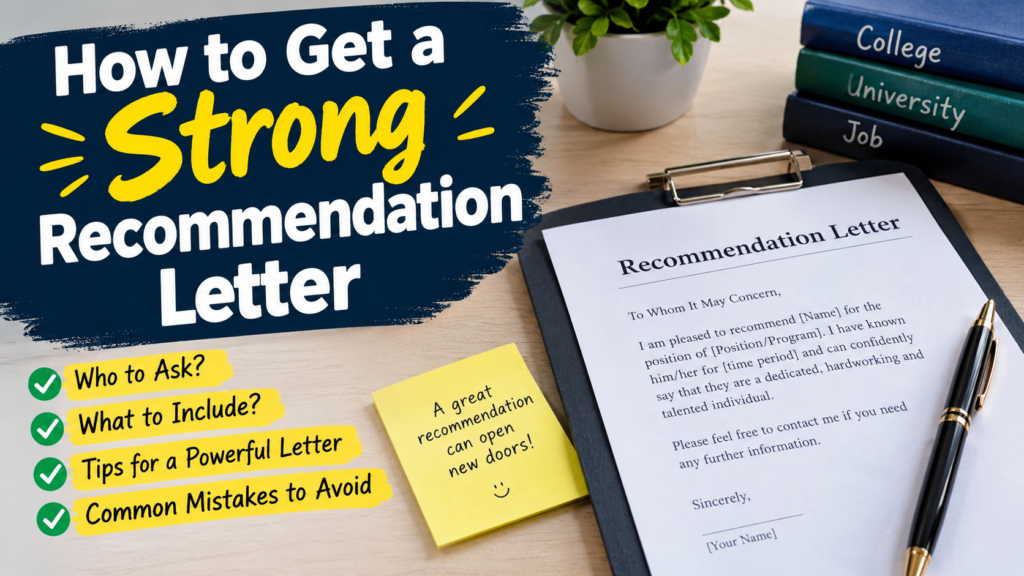
How to Get a Strong Recommendation Letter In 2026?
Don’t be ashamed to ask for a recommendation letter Let’s be honest: it’s a little uncomfortable to ask someone to put their time and effort into writing a recommendation for you to strangers. Are you sure you want me to spend hours of my time telling people how great you are? Yes, yes you do.
Most of your scholarship applications will have essays, transcripts, and forms where you control the content. Recommendation letters are other people speaking about you. And that is precisely why they are so important. When a teacher or other mentor spends the time to write something specific and sincere about you, that matters more than any personal statement ever could.
So how do you actually get one of these letters? And more importantly, how do you make sure it’s impactful – and not just the generic “they’re a great person, it could be about anybody” type of letter? With this guide, we’ll take you through the process, from deciding whom to ask for a letter of recommendation to post-letter etiquette. Whether you’re applying for a fully-funded international scholarship or a local prize, these tips will help you get letters that truly bolster your application.
What Makes a Recommendation Letter Strong (vs. Forgettable)
Not all recommendations are equal. Vague and boilerplate recommendations do almost nothing to influence decisions. Specific and powerful recommendations make a huge difference.
What’s the difference?
Those are specific. Stories are specific. They include bits and pieces that only someone who knows you very well would be able to include. A good strong letter will read: “When our laboratory machine broke down 48 hours before the deadline, Ahmed kept the lab open all night trying to fix the problem and devised a means to proceed with the experiment.” Now that’s memorable. Now compare that to: “Ahmed is a diligent and responsible student.”
Powerful letters put you in the top percentile. Reviews want to understand how you stack up. A professor who claims “this student is in the top 5% of students I’ve taught in my 15 years of teaching” provides something for the committee to work with. Percentiles and ratings help decision-makers get you.
Effective letters make the scholarship matter. If you’re applying for a research scholarship, an effective recommendation letter discusses your research potential; if you’re applying for a leadership award, the letter discusses your inspiring others and overcoming challenges. Letters that appear to be one size fits all aren’t as effective, and make it seem as if your recommender didn’t have time to write that personal of a letter!
Choosing the Right Recommenders
This is where many students make their first mistake. They ask the professor with the most impressive title, or the one who gave them the highest grade. But those aren’t always the best choices.
Who Should Write Your Letter?
The ideal recommender is someone who:
- Knows you well enough to write specific, detailed examples
- Can speak to qualities the scholarship cares about (academic ability, leadership, research potential, community involvement)
- Has seen you perform in a relevant context a professor in your field, a research supervisor, a project mentor
- Will actually have time to write a thoughtful letter before the deadline
For most scholarships, professors and research mentors are the best choices. If you’ve done internships or volunteer work that’s relevant to the scholarship, a supervisor from that experience can also work well. What you want to avoid is asking someone who only knows you by your grade in their class. If a professor has only seen your exam scores and never interacted with you beyond that, their letter will likely be generic.
Who Should You Avoid Asking?
Don’t ask family members or close personal friends even if they’re professionals. Scholarship committees expect academic or professional references. A letter from your uncle, no matter how accomplished he is, won’t carry credibility .
Also avoid asking someone whose class you performed poorly in. If you got a C in a professor’s course, they genuinely cannot write a strong letter about your academic abilities and asking them puts both of you in an uncomfortable position .
How Many Letters Do You Need?
Most scholarships require two or three letters. Check the requirements carefully. Some programs want a specific mix for example, one research mentor and one academic instructor. Plan ahead so you’re not scrambling to find a third writer at the last minute.
How to Request a Recommendation Letter (The Right Way)
The way you ask matters. A rushed, last-minute request or worse, a demand doesn’t inspire anyone to write their best work on your behalf. Here’s how to do it properly.
Step 1: Ask Early, Way Earlier Than You Think
Notice at least four weeks, preferably more, to your recommenders. Professors have their own jobs. They’re preparing for class, grading your work, doing their own research, and taking care of everything else in their university lives. Asking for a recommendation takes time-and an hour here, and an hour there-means it will be a rushed letter.
Step 2: Ask in Person (or at Least Politely)
In an ideal world, you would be able to meet with the potential recommender in person. If not, a professional email will do. Just don’t send a quick note to their mailbox or shoot them a text. Be professional.
Must ask phrase: “Do you feel you are able to write a compelling letter for me?”
This allows them to deflect without committing, in case they don’t feel they know you well enough. (In fact, this is a good sign it’s good to learn of a hesitant letter writer early.)
Step 3: Provide Everything They Need
Don’t make your recommender hunt for information. Put together a packet that includes:
- Your resume or CV
- Your transcript (even unofficial)
- Your personal statement or scholarship essay. this gives us insight into your aspirations and how their letter can enhance what you’ve written.
- Information about the scholarship. what it is for, how to apply, the deadline and any specific questions they have to answer
- A “highlights sheet”. A short list of things you’d like them to touch on if applicable (specific projects, awards, leadership experiences)
Certain scholarships require a unique form or submission system online. If this is the case, do your portion of the form first, and then direct them to the link. Don’t assume that they will figure out the system on their own.
Step 4: Be Clear About the Deadline and Submission Process
Make them aware of the deadline and the method of delivery – whether it should be uploaded to an online portal, submitted as a PDF, or sent in the post in a sealed envelope. If the latter, include a pre-paid, addressed envelope.
Step 5: Follow Up (Gently)
You can be courteous and give a gentle reminder a week ahead of the deadline, but don’t send a bunch of reminders. One is all you need. The last thing you want to be is annoying or desperate.
Once they turn the letter in, thank them. A hand-written note would be great, but a heartfelt e-mail is always welcome. And if you get the scholarship, be sure to tell them. They’ll be glad to hear you got it.
What Information Your Recommender Actually Needs
Let’s clarify that part a little more, because this is where students tend to get it wrong.
A professor who introduced you to the field two years ago might remember your face, but not all the work that you do. You may be just one of hundreds of students who they have taught. You can’t expect them to remember that stellar paper you submitted or that presentation you did.
That is why you should be offering:
A brief outline of your relationship. How long they have known you, what classes taken together, projects you did with them. Bring back memories.
Particular examples you’d like to have points. Did you carry out a analysis undertaking that confirmed your downside fixing skills? Had been you the chief of a staff undertaking? Give them one thing to work with.
Context about the scholarship. A letter for a need-based scholarship might emphasize different qualities than one for a merit-based research award. Help them understand what the committee is looking for.
Your future goals. Connect the dots for them. How does this scholarship fit into your larger plans? What do you hope to accomplish? This helps them write a letter that shows vision and purpose, not just past achievements.
Common Mistakes
Even well-meaning recommenders can produce weak letters if they don’t have the right information or enough time. Here’s what to avoid.
Mistake #1: Asking too late. We’ve said it, but it bears repeating. Late requests lead to rushed, generic letters.
Mistake #2: Choosing the wrong person. A Nobel laureate who barely knows you will write a worse letter than an associate professor who supervised your research for two years.
Mistake #3: Not providing enough information. If your recommender has to guess about your accomplishments, their letter will be vague.
Mistake #4: Skipping the “will you write a strong letter?” question. Asking directly gives them an out if they can’t write positively. A lukewarm or faintly negative letter is worse than no letter at all.
Mistake #5: Forgetting to check whether the letter was submitted. Online systems can fail. Emails can get lost. Confirm that your letter actually arrived before the deadline.
Also Check: Scholarship Interview Preparation 2026: Tips for Pakistani Students
Quick Comparison: Strong vs. Weak Recommendation Letters
| Feature | Strong Letter | Weak Letter |
|---|---|---|
| Specificity | Includes detailed stories and examples | Generic praise that could apply to anyone |
| Comparison | Ranks you against peers | No context for how you compare |
| Relevance | Addresses scholarship criteria directly | Off-topic or only discusses grades |
| Length | 1-2 pages, substantive | A few vague paragraphs |
| Writer’s knowledge | Deep, personal familiarity with you | Superficial relationship |
| Tone | Honest, evidence-based confidence | Hyperbolic or faint praise |
Frequently Asked Questions
How far in advance should I ask for a recommendation letter?
Give your recommender at least four weeks, and more is better. For major national or international scholarships, six to eight weeks is safer, especially during busy academic periods.
What if my professor doesn’t remember me well?
This is common, especially if you took their class a while ago. Meet with them in person if possible, bring your materials, and gently remind them of specific projects or papers you completed. If after that conversation they still seem unsure about you, consider asking someone else.
Can I ask the same person to write letters for multiple scholarships?
Yes, but each letter should be tailored to the specific scholarship. A generic letter that’s sent to five different programs won’t be as effective. Provide your recommender with information about each scholarship separately.
What if my recommender asks me to write the letter myself?
This happens sometimes, but it’s ethically problematic and many scholarships explicitly prohibit it. Politely decline and explain that you’re not comfortable with that approach. If they insist, you may need to find another recommender.
How do I know if a letter was actually submitted?
Check the scholarship’s online application system if available. Many systems show the status of recommendation letters. If you’re unsure, politely follow up with your recommender a few days before the deadline.
Is it okay to send my recommender a reminder?
Yes, one polite reminder about a week before the deadline is fine. But don’t send multiple messages or appear demanding. Remember, they’re doing you a favour.
What should I do if my recommender misses the deadline?
Contact the scholarship office immediately. Some programs allow a brief grace period for recommendation letters. Also follow up with your recommender, but stay calm and professional. If this recommender becomes unreliable, you may need to find a backup for future applications.
Conclusion
They’re not about asking someone who has a recognizable name. Great recommendation letters are about developing relationships with professors and mentors who can write (with earnest conviction) how they know you’re awesome.
So here’s the secret-by the time you need the letter, the work has already been done. Drop into office hours. Contribute to the class. Sign up to do research or a project. Keep in contact with your instructor afterward. When you’re ready to request a recommendation, you’ll be doing so from someone who actually has a clue about you-and that makes a huge difference.
One more thing: Never underestimate the power of gratitude. Your recommenders write letters to support you. A heartfelt thank you, a handwritten note, or your opportunity to share good news with them makes a difference-and means they will be happy to write for you again.
Have a look at those deadlines now. Your recommenders will thank you for the reminders.
The above list is only a guide for an overview of scholarship deadlines and requirements. Refer to the scholarship website or the university website as every detail may differ and keep abreast with the latest updates.