Required Documents for Scholarship Applications (2026)
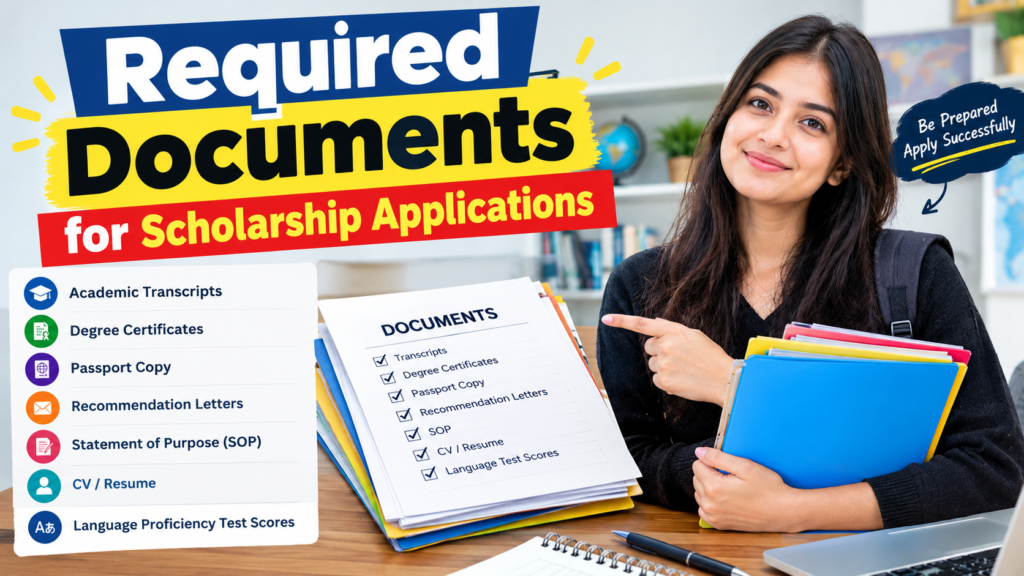
Required Documents for Scholarship Applications (2026). You’ve found the right scholarship for your profile. Perhaps it is complete with funding. Perhaps it offers you tuition and living expenses. You begin to complete the application, and then you see it: a long list of paperwork. Now, that opportunity doesn’t seem so appealing.
I understand. As a coach who has mentored thousands of students through the application process, I know how difficult it can be to get everything in the order it needs to be. Just one missing document or failure to follow instructions is enough to get you rejected not because you’re not qualified, but because your application is incomplete.
In this guide, we’ll: Show you what documents you need for your application; Teach you what you need each one of them; Help you know how to prepare your documents so they’ll stand out.
What Are Required Documents for Scholarship Applications?
Documents for Scholarship Applications. For every scholarship application you fill out, you will be asked to upload documents supporting your identity, courses you have taken, and your achievements. Think of it this way: You are applying for a scholarship that the scholarship committee members have never heard of. Your documents are your first impression.
It depends a little on the program, country, and year of study. An application for a Stipendium Hungaricum can be somewhat different than an application for a Fulbright which can be different than an application for a local needs-based scholarship. However, they have some things in common.
Here’s what you’ll typically need.
Core Documents: The Universal Checklist
You will find these in nearly every scholarship application. The peace of mind these will give you when you’re applying to other schools is priceless.
Academic Degrees and Transcripts
Your education summary gives us the starting point for your scholarship application. You will be required to:
- Degrees or certificates for all your completed levels such as (Matric, Intermediate/ HSSC, Bachelor, Masters)
- Transcripts of records your grades and courses
- Translations official if your documents are in Urdu or are otherwise not accepted by the host institution
You might only require scanned copies of the documents at the application stage for some scholarships. For others, you might need the attested hard copies at a later stage. An example of this is the Stipendium Hungaricum of the HEC which accepts the online documents during the application stage but IBCC & HEC attestation afterwards. Documents for Scholarship Applications.
Passport or National ID
Proof of age and nationality. Many international scholarships ask for a valid passport. If you have not yet obtained one begin the application process early it may take several weeks in Pakistan.
Some programs will take your CNIC for the application phase but you require a passport before you can actually travel or at least before you get final selection.
English Proficiency Test Scores
That’s where a lot of Pakistani students get snagged on it. The requirements are all over the place:
- IELTS or TOEFL: Common for European, UK, and Australian scholarships
- Some courses will consider a letter from your University stating that your education was in English.
- Some scholarships including some HEC provided scholarships do not require IELTS at the time of application. Documents for Scholarship Applications.
It also has a scholarship program of its own, the Heydar Aliyev which demands a minimum IELTS of 5.0 for undergraduates and 5.5 for postgraduates. The HEC, on the other hand, claims that – Stipendium Hungaricum has no IELTS requirements although the host university may require an IELTS exam.
Check the specific scholarship’s rules. Don’t assume
Curriculum Vitae (CV) or Resume
A succinct, professional CV is almost always specified. Stick to 1-2 pages. Concentrate on:
- Education
- Relevant work or volunteer experience
- Research projects or publications
- Awards and achievements
- Skills and languages
Stick to a simple layout. Extravagant fonts won’t earn a woman any bonus points with her committee. Documents for Scholarship Applications.
Statement of Purpose or Motivation Letter
hance to speak directly to the selection committee. You explain:
- Why you want this scholarship
- Why you chose this field of study
- How the scholarship fits your goals
- What you plan to do after graduation
All the programs have various names: Statement of Purpose; Motivation Letter; Personal Statement; Letter of Intent; They’re similar but not quite the same. A motivation letter tends to be more personal and emotional, while statement of purpose is more academic. Documents for Scholarship Applications.
Letters of Recommendation
Most applications require two to three reference letters. These can be from any combination of professors, mentors, supervisors or employers who can comment on:
- Academic ability
- Work ethic
- Character
- Potential for success
A generic letter that could describe anyone is worse than useless. Choose recommenders who know you well and can give specific examples.
Also Check: Need-Based Scholarships 2026 Guide: How to Apply & Qualify
Additional Documents by Scholarship Type
Beyond the core set, specific programs may ask for:
Research Proposal (PhD Applicants)
Don’t forget the details. Each program will have instructions on formats, attestation, and deadlines. Create a checklist and keep track of everything you complete!
Medical Certificate
Other applications ask for a health clearance. Generally, this will be a form of clearance for good health, but some applications need an HIV/AIDS or Hepatitis B/C check as well. Some only want this after you’re selected, not when you’re applying. Documents for Scholarship Applications.
Police Clearance Certificate
If you’re studying in some countries, you might be required to get a police character certificate showing you don’t have a criminal history.
Financial Documents
Provision of family income is the criterion for need-based scholarships. Authentic documentary proof of income and expenditure of the household in the form of ‘family income statement’ shall be provided by the student for Ehsaas Undergraduate Scholarship and verified by the scholarship committee.
Test Scores (GRE, HAT, USAT)
Certain scholarships necessitate standardized test scores. The Fulbright program necessitates GRE scores HEC scholarships may require HAT or USAT scores with designated expiration periods.
Acceptance Letter or Invitation
Certain scholarships will ask you to provide evidence that a host university has accepted you. For research scholarships, a letter of invitation from a professor or a university may be required. Documents for Scholarship Applications.
Scholarship Documents at a Glance
| Document | Who Needs It | When to Submit | Special Notes |
|---|---|---|---|
| Passport/CNIC | All applicants | Application stage | Passport may be required before travel |
| Degrees & Transcripts | All applicants | Application stage | Attestation may be needed after selection |
| IELTS/TOEFL | Most international programs | Application stage | Minimum scores vary; check requirements |
| CV/Resume | All applicants | Application stage | Keep it concise and relevant |
| Motivation Letter/SOP | All applicants | Application stage | Customize for each scholarship |
| Recommendation Letters | Most programs | Application stage | 2-3 letters; specific examples matter |
| Research Proposal | PhD applicants | Application stage | Must align with supervisor’s expertise |
| Medical Certificate | Many programs | After selection (sometimes) | Includes specific health screenings |
| Police Certificate | Some countries | After selection | Valid for limited period |
| Financial Proof | Need-based scholarships | Application stage | Income verification is strict |
How to Required Documents for Scholarship Applications?
Step 1: Read the Requirements Carefully
Read all instructions carefully. Each program will have different requirements for style, attestation, and deadlines. Keep a list of what you need to do and mark it off as you do it.
Step 2: Start Early
It may take weeks to get some of the documents. Passports, police verifications, attestation of IBCC or HEC and test scores demand time. Beginning even a month before the deadline can result in panic.
Step 3: Get Official Translations
Translate documents into certified English versions which might be done by your university some scholarships accept this or by a notary or other legit translation agency.
Step 4: Attest Where Required
HEC and IBCC. The great majority of scholarships don’t require attestation at the first stage of the application only once you’ve been selected. Read the programme’s instructions to save yourself the time.
Step 5: Scan Everything Properly
Online is the preferred method: Scan as easily readable PDFs. Name files in a way that will be easy to identify (ex. BSTranscriptName.pdf).
Step 6: Keep Both Digital and Physical Copies
Accept digital submissions (most do), however, you might have to mail hard copies of your documents or actually bring them in to a financial aid office. Make sure you have folders of all.
Common Mistakes to Avoid
Submitting incomplete applications. A missing transcript or unsigned recommendation letter can get your application rejected before it’s even reviewed. The HEC explicitly states that incomplete applications will be rejected.
Lying or exaggerating. Fabricating achievements or altering documents is not just unethical, it can result in disqualification even after you’ve been selected. Scholarship committees verify information.
Using generic recommendation letters. A letter that says “This student is good” tells the committee nothing. Ask your recommenders to include specific examples of your abilities.
Replicating your personal statement. If you’re asked for both a personal statement and a motivation letter, don’t submit the same document twice. Each serves a different purpose.
Missing deadlines. Deadlines are firm. Some programs have multiple stages with different deadlines don’t confuse the application deadline with document submission deadlines.
Ignoring instructions about format. If the program says “PDF only” or “maximum 2 pages,” follow it. Disregarding instructions signals carelessness.
Frequently Asked Questions
What documents are absolutely required for scholarship applications?
The core set includes academic degrees and transcripts, a valid passport or national ID, a CV, a motivation letter or statement of purpose, and recommendation letters. Most scholarships require these. Additional documents like IELTS scores, medical certificates, or research proposals depend on the specific program.
Do I need IELTS for all international scholarships?
No. Requirements vary. Some scholarships require IELTS or TOEFL, while others accept an English proficiency certificate from your university or don’t require proof at the application stage. For example, HEC doesn’t require IELTS for Stipendium Hungaricum, though some Hungarian universities do.
How many recommendation letters do I need?
Most programs ask for 2-3 letters. PhD programs may require more, including one from a potential supervisor. Quality matters more than quantity choose recommenders who know you well.
When should I start gathering documents?
Start at least 2-3 months before the deadline. Passport processing, test registration, attestation, and translations all take time. Starting early also gives you room to handle unexpected delays.
Do I need to attest my documents before applying?
For many scholarships, no. Attestation from IBCC or HEC is often required after you’re nominated, not at the initial application stage . However, some programs do require attested copies upfront. Read the instructions carefully.
What if my documents are in Urdu?
You’ll need official English translations. Some universities provide translation services; otherwise, use a certified translation service. The translation must be accurate and often notarized.
Can I apply with a provisional certificate?
Some programs accept provisional certificates, while others require final degrees. If you’re in your final year, check whether the scholarship allows conditional applications.
Conclusion
Getting your documents in order for scholarship applications isn’t the most exciting part of the process. It’s monotonous, at times, frustrating and often confusing. However, it’s not impossible.
Here’s what I want you to remember: the documents are not the obstacle. They are the proof. Every transcription, every recommendation, every meticulously written motivation letter is a testament to the fact that you are ready for this wonderful adventure. The committee does not know you yet these documents do tell the story.
Start early. Understand the instructions. Take your time. If you’re frantic, think about your reasons for doing this.
Your future is worth the paperwork.
The information in this post is for informational purposes only. Scholarship requirements, deadlines, and the list of documents needed can change from year to year. Before applying always check the scholarship or university website for the latest requirements.