
Engineering Scholarships Guide 2026: How to Find and Win Funding
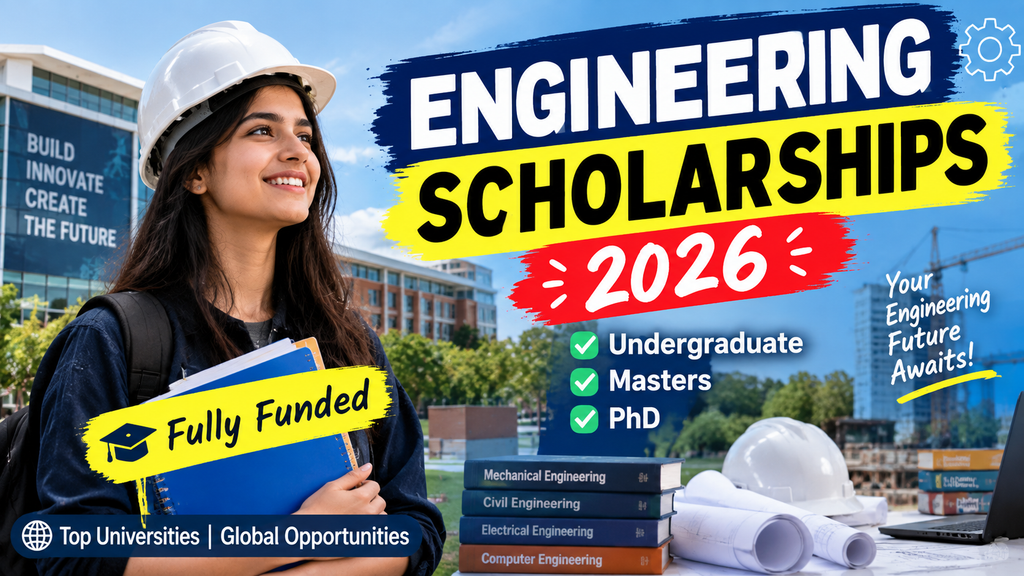
Engineering Scholarships Guide 2026: How to Find and Win Funding. Let’s be honest: Engineering is one of the costliest degrees you will ever want to go after. With tuition fees, lab equipment, textbook costs, living expenses- it can get way too high when looking through the prism of Pakistan or your panoply. Here is the deal that most students don’t get to see early on: There is more money out there for engineering students than in almost any other subject. The only thing is-you need to know where to find it, apply for it and can’t do it.
Engineering scholarships resource: The Complete Guide to Engineering Scholarships This is your step-by-step guide. Not just a list of programs, but the nitty-gritty what committees are really looking for, what errors get applications kicked out, and what you need to do to make a timeline that doesn’t make you panic a week before the deadline.
Whether you’re a bright high school student, an engineering bachelor’s student feeling the pressure of fees, or a master’s aspirant looking to study abroad, this article will put things into perspective for you. So, without further ado.
What Are Engineering Scholarships?
Engineering scholarships are discounts on the cost of attending college or university for students studying engineering. for example, computer, aerospace, mechanical, electrical, and civil engineering. Many are targeted scholarship competitions held by universities, governments, professional associations, and other private foundations to strengthen and support the engineering industry.
There are a variety of fellowships to look for-they vary in size, scope, and application process. Some are all-encompassing, paying not only for tuition and accommodation but also a stipend for living expenses and perhaps even airfare. In Pakistan, the Higher Education Commission (HEC), the country’s government, and universities themselves all offer a range of scholarships, including private schemes. Pakistani universities and students interested in studying in Pakistan can also apply to the Allama Muhammad Iqbal Scholarship for Central Asian and other friendly country students to study engineering and technology.
The most important thing to realize is that engineering scholarships are not only for “geniuses” and the straight-A students. Several scholarship review committees take into account your motivation, research potential, financial need and if your goals and motivations align with what they want to accomplish. So even if your GPA is less than perfect, you still have hope.
Eligibility Criteria For Engineering Scholarships
Don’t waste time on an application that’s just not a match before you do all that work, see if you are actually eligible. Every program is different, but here is a general guideline of what most engineering scholarships are looking for:
- Study options: FSc Pre-Engineering, A-Level or other equivalent with good marks. Engineering courses: For engineering courses most require 60-65% minimum.
- Nationality: A few of scholarships are available only to Pakistani nationals. Several, such as the Chinese Government Scholarships or the Stipendium Hungaricum, are available only to students from certain developing countries.
- Level of study: There are individual scholarships for undergraduate, master’s, and PhD level. Do not apply for a PhD scholarship if you are still in your bachelor’s.
- Language ability: International scholarships sometimes require IELTS or TOEFL; some Chinese scholarships have also begun to accept English-taught certificates from previous schools.
- Must be aged 40 to 60: Phd’s are most eligible. It might also be just one of the criteria you meet. Are you aged 40 to 60?
- Requirements for scholarships in Africa: Phd ‘s are far more competitive. Are you aged 40 to 60?
- Age restrictions for PhD scholarships in Africa: PhD’s are really competitive. (Need PhD funding? Request a PhD proposal here). Are you aged 0 to 4?
- Age requirements for Master’s Scholarships: Masters awards are generally are awarded up to 35 years of age. [ Do you have a Master’s degree? Five. Have you completed your Master’s Degree?
Important tip: Some scholarships have you apply to the university first, then go in for the scholarship, and other programs want you to apply at the same time. What you should do is read the directions carefully, you don’t want to submit applications in the wrong order-it’s the number one reasons applications get rejected.
What Do Engineering Scholarships Cover?
Now, here’s where it gets interesting. Each program has varying package offerings, but this is what you may find:
Full funding typically includes:
- Complete tuition coverage
- Monthly living stipend
- Free or subsidized accommodation
- Medical insurance
- Round-trip airfare (usually once)
- Book or research allowances
Partial funding might cover:
- Tuition fee waiver only
- A fixed annual amount
- Research costs
- Conference travel
Korean Universities’ Asian Scholarship This includes the KOICA-Yeungnam University program in South Korea which also provides free tuition fee, 1,200,000 KRW per month, campus accommodation, airfare, Korean language training and much more. Chinese Government Scholarship includes free tuition, accommodation, stipend and also covers the medical insurance. Allama Iqbal Scholarship, Pakistan provides tuition, accommodation, a monthly stipend and travel expense
| Scholarship Program | Degree Level | Coverage | Key Deadline |
|---|---|---|---|
| Allama Muhammad Iqbal Scholarship | Undergraduate | Full tuition, accommodation, stipend, travel | August 10, 2026 |
| Stipendium Hungaricum | Bachelor’s/Master’s/PhD | Tuition-free, stipend, accommodation, insurance | Varies (HEC portal) |
| Chinese Government Scholarship (Silk Road) | Master’s/PhD | Tuition, accommodation, stipend, insurance | May 15, 2026 |
| KOICA-Yeungnam University | Master’s | Full tuition, KRW 1.2M/month, housing, airfare | April-May 2026 |
| COMSTECH-University of Wah MS | Master’s | Tuition, airfare, accommodation, meals | Fall/Spring intakes |
| Ferguson Trust (Manchester Met) | Master’s | Full tuition ( | May 31, 2026 |
Documents You’ll Need
This is the tedious bit but it is important. Missing documentation is one of the most common reasons for rejection sometimes after weeks of waiting.
Here’s a general list of what to bring on your scholarship interview:
- Academic transcripts and certificates attested/notarized
- Passport copy valid for at least 6 months beyond your intended stay
- English proficiency test scores (or medium-of-instruction certificate
- Statement of Purpose or Motivation Letter
- Research proposal for master’s/PhD applications
- Recommendation letters usually 2-3 from professors or employers
- CV/Resume academic-focused not your job history
- Passport-size photographs
- Medical examination form for many international programs
- Application fee receipt
Pro tip: Gather these papers two to three months out. It will take longer than you think to attest transcripts, ask for recommendation letters, and obtain everything. I know students who have lost amazing scholarships and programs because their teacher was on vacation and was unable to sign their recommendation letter.
Also Check: DAAD Scholarship for Pakistani Students: 2026 Guide
How To Apply For Engineering Scholarships?
Step 1: Shortlist Your Scholarships
Don’t just fill out applications everywhere. Choose 3-5 programs where you fit the criteria well, and your profile fits what they’re looking for. Read the eligibility paragraph twice. If it says “research experience required” and you don’t have it, then you’re probably throwing away your time unless you’ve got some solid work experience in lieu of it.
Step 2: Prepare Your Documents Early
Make a folder (physical and digital) with all your documents. Scan everything at high resolution. Name the files clearly – “Transcript_Fall2025.pdf” not “document1.pdf” Committees are aware of these little things.
Step 3: Drafting Your Statement of Purpose
This is where most of the applications are made or broken. Your SOP is NOT a CV in the form of a paragraph. It is about as to why you want to do engineering, what your aspirations are and why this program.
Bored of starting every other interviewee reply with “Since I was a kid, I have always wanted to be an engineer”? Here’s the chance to get creative and think outside the box. Use a specific incident, project or problem that triggered your passion.
Step 4: Secure Strong Recommendation Letters
Ask professors who you have a real relationship with, rather than the first ‘highest-ranking’ person you happen to come across. A detailed letter from a supervisor of your final-year project will far trump a bland, boilerplate letter from a department head who can’t quite remember your name.
Step 5: Submit Before the Deadline
No-brainer, I know, but I can’t tell you how many students still miss out on opportunities because their portal crashed at 11:58 p.m. on deadline night. SUBMIT AT LEAST 48 HOURS EARLIER. Keep copies of confirmation emails and application numbers.
Step 6: Prepare for Interviews
Some awards particularly research ones interview. Practice talking through your research interests. Make sure you are familiar with your own CV you will be asked about the projects you have listed.
Important Dates and Deadlines
On average deadlines are scattered quite a bit, but there is a typical pattern you will see:
- Chinese Government Scholarships December-January: applications open May: deadline for applications July: notification of selection results usually
- HEC-funded scholarships: Last dates are publicized on HEC portal, sometimes in the middle of the year.
- Korean Government Scholarships: Applications typically open April-May for September intake
- UK scholarships: Usually in May for September intake.
- University-specific scholarships: Search each university’s financial aid page
My tip? Make a spreadsheet with a tab for the name of the scholarship, deadline, requested documents, application status and date submitted. It’s nerdy, but it helps.
Tips to Increase Your Chances
Custom-edit each application. If you send the same statement of purpose to ten universities, all will dismiss it. Invest time investigating each university, department, research group, and professor whose research attracts your attention.
Show off your research & projects. Engineering committees love to see what you’ve made, written, designed, or experimented with. Even your year 4 project with mediocre results demonstrates that you finish what you start.
Demonstrate connection to program objectives. If the funding for your scholarship comes from your country’s government wanting to develop infrastructure, state how your engineering degree will help do this. If it is a university research scholarship, relate your interest to that of faculty members’ interests.
Motivation letter-some programs prioritise this more than grades. Write it as if you were speaking with someone and are sharing your story, not completing a form.
Ask for advice. Get an experienced student who secured a scholarship before to read your SOP and CV. They will be able to point out what you have missed.
Common Mistakes to Avoid
Copy pasting from the web. Committees have read a couple thousand applications. They know a template SOP when they read one. Write your own SOP, flaws and all.
Not applying the right way. Some scholarships ask that you apply through HEC. Others want you to apply directly to the university. Some ask for both. Know before you go.
Poor recommendation letters. If your recommender wants you to “write something and I’ll sign it,” leave it in the dustbin, say Ma. Ask him or her to write a regular recommendation, or find another recommender.
Overlooking the small print of the eligibility criteria “Open to OIC member states”. Do check if Pakistan is listed. “Minimum GPA 3.0” go ahead if you have 2.9 and are planning on getting a rejection.
Applying without required tests. Numerous guidelines require IELTS/TOEFL scores when you apply. Never think you will be able to submit the scores at a later date.
Deadlines missed. Portals shut. Emails ignored. Prepare to wait.
Frequently Asked Questions
Can I apply for multiple engineering scholarships at once?
Yes, you can apply for multiple scholarships. However, some programs explicitly state that recipients cannot hold other scholarships simultaneously. Always check the terms. Applying for several opportunities increases your chances just be honest about it if asked.
Do I need IELTS for engineering scholarships?
Not always. Some Chinese Government Scholarships and programs accept English-medium instruction certificates from your previous university . However, for most competitive international scholarships, an IELTS score of 6.0 or above strengthens your application significantly.
What CGPA do I need for a fully funded engineering scholarship?
It varies. Some programs accept a minimum of 2.0/4.0, but competitive scholarships typically look for 3.0 or higher . If your CGPA is below 3.0, focus on programs with lower thresholds and compensate with strong research experience and a compelling SOP.
How long does the engineering scholarship application process take?
From document preparation to final result, expect 4-8 months. Application windows are usually 2-3 months, followed by evaluation and interview stages. If the scholarship includes visa processing, add another 1-2 months.
Can I apply for an engineering scholarship without research experience?
For undergraduate scholarships, yes research experience isn’t typically expected. For master’s and PhD programs, research experience helps enormously but isn’t always mandatory. If you lack formal research, highlight substantial projects, internships, or technical work.
Are there engineering scholarships specifically for Pakistani students?
Yes. The Allama Muhammad Iqbal Scholarship is available for international students to study in Pakistan, including engineering . Pakistani students also have access to HEC-administered programs like Stipendium Hungaricum , the Chinese Government Scholarship , and various university-specific opportunities.
Conclusion
Chasing engineering scholarships can seem like a full-time job – and it is. You’ve got the hours of filling out online forms, the papers to write, the waiting for your to be written. But here’s the thing: engineers win these scholarships all the time. They’re not any smarter than you – they just got an early start, and followed the right steps.
You don’t have to have a stellar GPA to score funding. You just have to have a story, the correct documents, and the gumption to get them in before the due date. Begin with one scholarship.
Read the instructions.
Collect your documents. Draft your SOP with honesty and detail. Then apply.
And what if you don’t succeed the first time? If you don’t succeed the first time, apply again. Plenty of people who became scholars the second, third, even fourth time, were turned down the first time. You learn stuff just by doing it: how to sell yourself, how to communicate your aspirations, how to deal with rejection, and so on.
You have the talent. Now you need the strategy. Begin today.
Please note: Scholarship amounts, deadlines, eligibility, and program information are subject to change without notice. This guide draws upon current knowledge of a number of typical scholarship program structures and it’s always best to double-check all relevant information directly with the provider.


One Comment