
IELTS Requirement for Scholarships 2026: What Score Do You Actually Need?
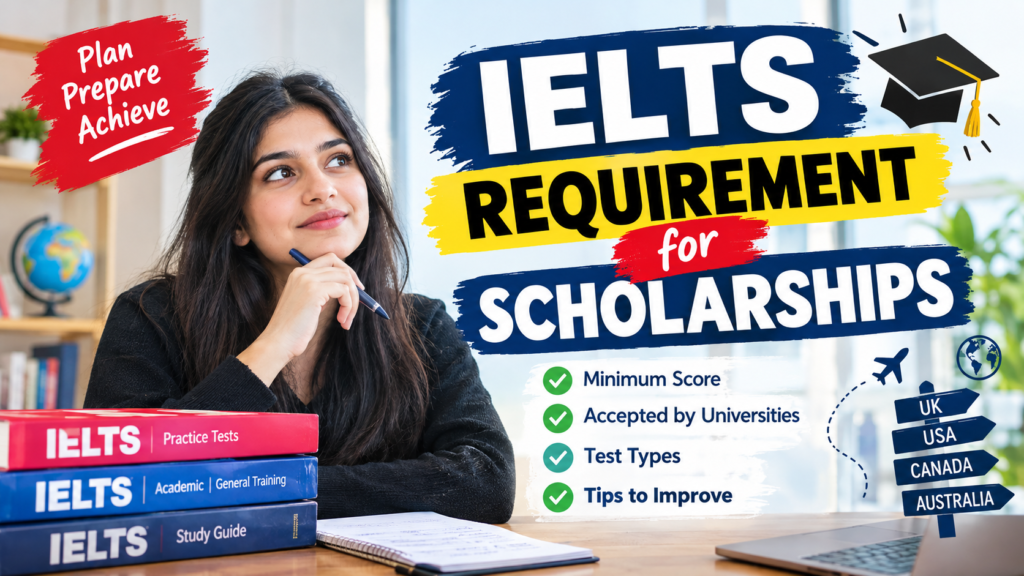
IELTS Requirement for Scholarships 2026: What Score Do You Actually Need?. You’ve been preparing for your scholarship application for months. Your grades are perfect, your motivation letter is polished, your references have sent their letters in on time. And then you see it in the requirements: ‘Evidence of English language proficiency’. And then you’re lost. What score do you need? Do all scholarships ask for the same? How bad is it to fall short by 0.5?
Here’s the brutal reality most students learn too late: scholarship IELTS scores are never one value. They differ by scholarship, by university, by country and can even change depending on what course you want to study. In this all-encompassing guide we show you exactly what each scholarship is looking for, when you need to sit the test and the silent mistakes that cost students scholarships.
What Is the IELTS Requirement for Scholarships?
If a scholarship states that you need IELTS that will usually mean IELTS Academic-not General Training. If you want to go to university and use IELTS to get in, then you need Academic IELTS, as this prepares you for lectures and academic reading and writing. IELTS Requirement for Scholarships.
Almost all fully funded scholarships have two types. The first category are scholarships that specify the minimum score for their own IELTS. Australia Awards, some Fulbright commissions, and others like Chevening and Commonwealth specify their own IELTS rule. You submit your result alongside your application, and if you score below the specified score, then you don’t qualify.
IELTS Requirement for Scholarships. But why does it make a difference? The difference is that it changes what your goal is. Knowing the place on the score to hit sets it for you, whereas if it’s the faculty on the lookout for it, you should have a look at particular course web page-and requirements could range completely.
IELTS Scores for Major Scholarships at a Glance
The following table includes information on the expectations for a selection of the most popular Pakistani & international scholarships, as offered by the universities below. Just to note: these are estimated ranges. Check the official scholarship page for the most up to date requirements for each admission year. IELTS Requirement for Scholarships.
| Scholarship / Program | Typical IELTS Requirement | Notes |
|---|---|---|
| Chevening (UK) | 6.5 overall, no band below 6.0 | No own English rule; must meet university condition by deadline |
| Commonwealth Master’s (UK) | 6.5–7.0 overall | Varies by university; no band below 6.0 typical |
| Fulbright (USA) | 6.5–7.0 (varies by country commission) | Check your local commission’s rules |
| Australia Awards | Fixed minimum set by program | Sets its own score; submit with application |
| DAAD (Germany) | 6.0–6.5 for English-taught programs | Many programs accept 6.0+; some require 6.5 |
| Erasmus Mundus | 6.5 overall | Often no band below 6.0 |
Regarding the university entry itself, the general bands would be (for most of the courses and university fields): 6.0-6.5 for undergraduate, 6.5-7.0 for master, 7.0+ for more selective Phd or research-level 7+.
Eligibility Criteria for IELTS Scholarships
Not every scholarship will require an IELTS score and not every applicant will need to take it. However, if you’re applying for a scholarship to study in the UK, Australia, Canada, or the US, a score is likely to be a requirement. IELTS Requirement for Scholarships.
Here is what generally qualifies you-and what may lead to an exemption:
- You are applying for a course in a country with medium or high endorment to English, such as UK, USA, Canada, Australia or New Zealand. In these countries, IELTS or a similar test will almost certainly be necessary.
- Your previous degree was taught completely in English. While some universities will accept an English-medium instruction certificate, others won’t. For example, this is not enough in the case of Germany’s Europa-Universitt Flensburg, which clearly states that English was the language of instruction does not constitute an acceptable certificate.
- You are a native English speaker. People born in an English speaking country are very often entitled.
- There is not an English requirement for this scholarship at all. Some programs, such as for some Japanese and Korean government scholarships, do not require IELTS.
If you are uncertain of the exemption you do not qualify for, please feel free to contact admissions directly. Don’t assume a rejected application.
Documents You Will Need
In addition to the score, many scholarship applications require a package of supporting documents. Getting these ready in time will save you a panic moment later. IELTS Requirement for Scholarships.
- Valid IELTS Academic Test Report Form
Academic transcripts and Degree certificate - Statement of Purpose or research proposal
- Letters of recommendation
- Valid passport
- Scholarship application form
Your IELTS score needs to be valid on the day the scholarship checks it. IELTS results are valid for two years. This is 1 January of the study year for Australia Awards and at your actual enrolment date for most UK universities and other awards. If your test is close to the end of validity, you may need to do another test even if you already have a good score.
Also Check: Engineering Scholarships Guide 2026: How to Find and Win Funding
How To Apply For IELTS Scholarship?
Step 1: Find Your Target Score
Begin at the scholarship’s page. If the link points to the university, click a course page, locate the English language requirements section. You want two numbers, one is total band score the other is the lowest section score. If one says 7.0 overall and 5.5 in Writing, that’s not going to pass a rule that says, “no band below 6.0”. IELTS Requirement for Scholarships.
Step 2: Take a Full Mock Test
Attempt a timed four-section IELTS mock (don’t forget to score it!) for your practice. You’ll discover your weakest section-and by how many points. Writing is the most common weak point in scholarship applicants-it also takes the longest to get better at.
Step 3: Work Backwards from the Deadline
This is where most students get caught. IELTS results take 3–5 days to arrive. Then the university needs time to process your score and update your offer. If you need a retake, add another month.
For a scholarship with a July deadline, aim to take your test by early March at the latest . That gives you buffer room if you need to retake. IELTS Requirement for Scholarships.
Step 4: Book the Right Test
You need IELTS Academic, taken at a test centre. IELTS General Training and IELTS Online are often not accepted for scholarship purposes . Double-check before you pay.
Step 5: Submit Your Score Correctly
Some scholarships want your score uploaded with the initial application. Others only need it from shortlisted candidates. Chevening, for example, does not require IELTS at the application stage only selected candidates take the test, with the British Council covering the cost in some cases. Read the instructions carefully so you do not submit documents that were not requested.
Tips to Increase Your Chances
Set your sights above the minimum. A score that secures you entry may not be competitive to apply for funding. Chevening’s minimum is 6.5 but successful applicants often have 7.0+ and Fulbright programmes often require 7.0+. IELTS Requirement for Scholarships.
Concentrate on your weakest band. When assessing each school, admissions should pay attention to the sectional scores and not your overall score. A 7.5 overall score with 5.5 in Writing begs the question as to whether you’re able to tackle school-writing.
Practice computer-delivered IELTS. IELTS is now offered on computer at most centres. Preparing in this way helps to remove some of the concern associated with computer-delivered testing.
Do not rely on a waiver. Even if you studied in English, many universities and scholarships still want a test score. Germany’s Flensburg explicitly rejects medium-of-instruction certificates.
Common Mistakes to Avoid
- Booking too late. Results take days, processing takes weeks, and deadlines do not move. Late scores are one of the most common reasons strong applicants lose funding .
- Taking the wrong IELTS version. General Training is not accepted for university admission or most scholarships .
- Ignore the band minimums. An overall high score does little good if you don’t hit the band minimums.
- Allowing your grade to time out. Two years sounds like a lifetime until it isn’t. Make sure your expiration date matches up to the verification period of the scholarship.
- Assuming all scholarships work on this principle. They could be very different from each other. Research each scholarship’s policies and procedures. IELTS Requirement for Scholarships.
FAQs
Do I need IELTS before applying for Chevening?
No. Chevening does not require IELTS at the application stage. Only selected candidates take the test, and the British Council often covers the cost. However, you must meet the university’s English condition by the scholarship’s deadline.
What is the minimum IELTS score for a fully funded scholarship?
Most fully funded scholarships expect 6.5 overall with no band below 6.0. Competitive awards like Fulbright or Gates Cambridge often require 7.0 or higher.
Can I get a scholarship with IELTS 6.0?
Yes, for some programs. Many undergraduate courses and some master’s programs accept 6.0. Australia Awards and certain DAAD programs may accept 6.0–6.5 . But competitive scholarships usually want more.
Is TOEFL accepted instead of IELTS?
Often, yes. Most universities and scholarships accept TOEFL iBT as an alternative. Check the specific requirements some programs have different minimum scores for TOEFL and IELTS.
How old can my IELTS score be?
IELTS results are valid for two years. The score must be valid on the date the scholarship or university verifies it, not just when you submit your application.
What if I miss the minimum by 0.5?
You can retake the test. There is no penalty for taking IELTS multiple times. Use your score report to identify the weak section and target your preparation.
Do scholarships cover the cost of IELTS?
Some do. Chevening covers the test fee for shortlisted candidates in certain countries . Most scholarships do not, so budget for the test fee yourself.
Conclusion
The IELTS for scholarships is not intended to be a barrier-it is a red flag. Universities and funding bodies need to see that you will have no difficulty managing the academic activities through English including seminar participation and writing your thesis.
If your score isn’t yet what it needs to be, that’s not a catastrophe. That’s data. That’s information. It’s pointing you in a direction. Do a practice exam, figure out how to work backwards from your deadline and treat yourself to a little bit of time. IELTS Requirement for Scholarships.
One last: Requirements are dynamic. Scholarship requirements are revised, Cutoff standards and deadlines are frequently updated by the scholarship body and university. Before you actually do any action using the knowledge from this article, visit the official scholarship website and university course website and validate the score, deadline and document requirements yourself. That 5 mins revision can provide you with the scholarship and not.
This post is for informational purposes only. IELT IELTS minimum scores, scholarship deadlines and criteria for eligibility are subject to change at any time without any prior notice. Please confirm the same from official sites of the scholarship.




One Comment